
Month-End is Just Another Day

Modern ERP platforms are flattening the financial calendar. A report this week from Rillet / a16z draws heavily on user base data to show how automated ledgers have shifted month-end close from a month-end sprint to a daily rhythm. The data and charts from this report are so rich and really highlight the value and level of disruption these modern ERPs are creating (and why everyone is talking about Rillet and Campfire).
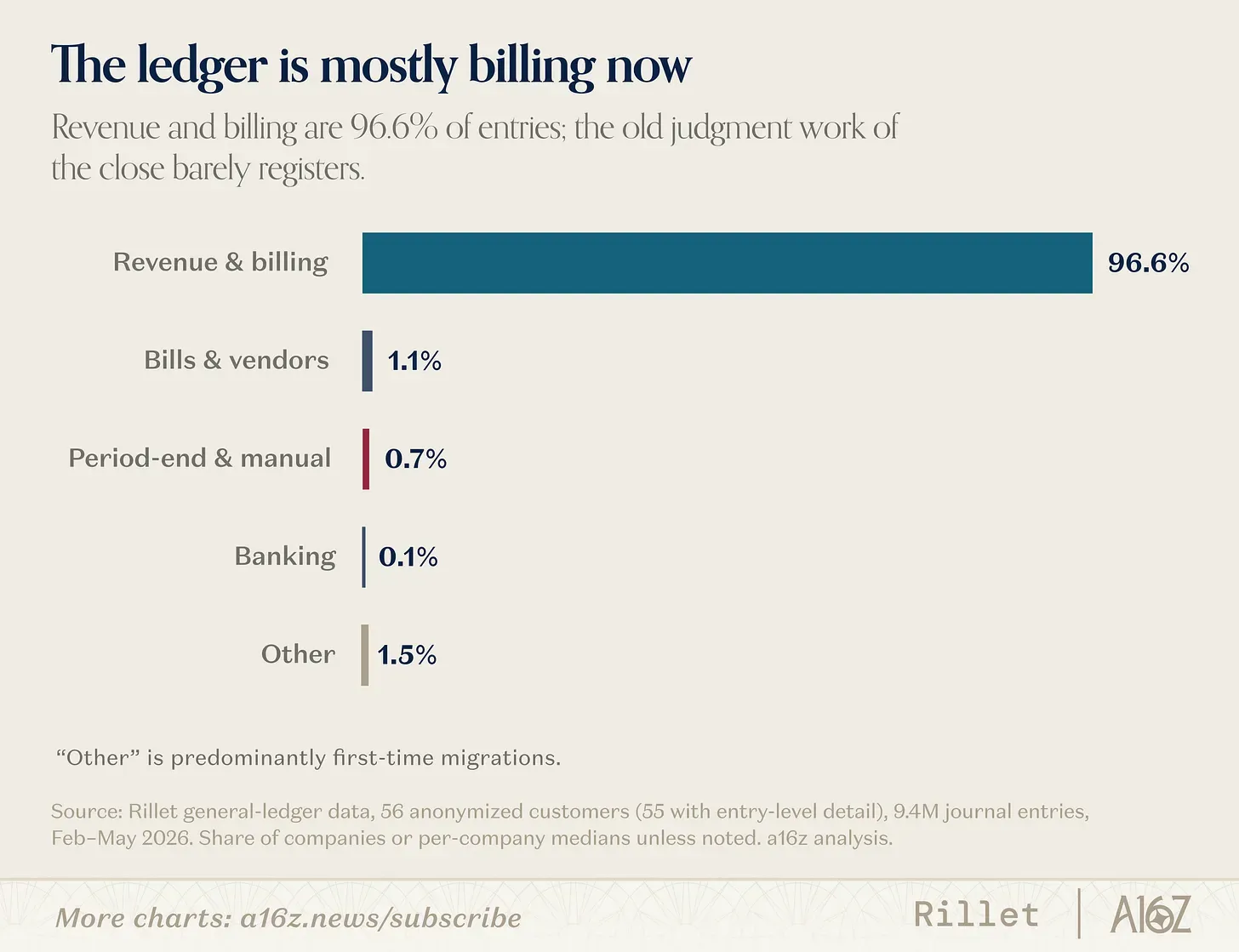
A few callouts.
When you select tools with native integrations across banking, spend, payroll, and billing, entries book themselves automatically throughout the month. This does not require artificial intelligence. It requires clean system architecture, strong native integrations, and proper data mapping.
Revenue & billing still require manual entries.
- For early-stage companies (i.e. you likely cannot afford Rillet / Campfire) there is also a lack of good, affordable revenue recognition software. Google Sheets / Excel calculations that get manually booked in QBO remain standard practice. I have been using a new system that is affordable, but would not call myself a net promoter of the software yet.
- For later-stage companies, even with the plethora of revenue automation tools, constant experimentation with pricing & packaging or bespoke contract terms leaves manual work to close revenue. With all of the experimentation around outcome-based pricing (which is really just a form of usage-based pricing), this is not getting more automated.
As noted in prior posts, even if you cannot afford Rillet or Campfire today, you can still achieve this cadence. The article highlights some of the underlying systems for banking, spend, payroll, billing and CRM, which are available to early-stage companies. Today, with Claude you can fill the gaps through workflow automations, daily reconciliations, anomaly detection, calculating allocations, booking transactions and a variety of other tasks you might otherwise push out until after month-end.
Finally, I do a lot of work in the HR Tech / Work Tech space, it would be really interesting to see one of the AI-native HCMs put out a report like this.